Mitral Balon Tedavisi
Kasık bölgesindeki toplardamarlar, bacaklarda ve kasık altı bölgedeki kirlenmiş kanı inferiyor vena kava adı verilen alt büyük toplardamar ile sağ kalbe ulaştırmaktadır. Anjiyografi laboratuarında, küçük bir iğne ile…
How is Mitral balloon valvuloplasty done?
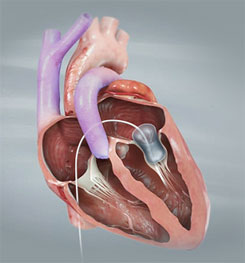
The veins across the groin take dirty blood from legs to right atrium. We make little punctures by a small needle to the femoral vein and put a sheath into the femoral vein at our catheterization laboratory. We send our little catheters from this sheath in to the right atrium. Then, we sent a special needle (Brockenbourgh needle) and make a transseptal puncture to cross from right to left atrium. After passing through the atrial septum, we put a specific halo shaped guidewire into the left atrium. Over this guidewire, a special balloon is sent to the left atrium. By using different maneuvers, we pass through the mitral valve and inflate the distal part of balloon in the left ventricle. Then we pull back the balloon and just across the mitral valve we inflate all segments of the balloon and dilate the stenotic mitral valve. After the procedure, the valve area is recalculated and the gradient across the valve is measured. If the valve is adequately opened, the procedure is terminated.
Can we use Mitral balloon valvuloplasty in all patients?
Mitral balloon valvuloplasty is not used for all patients with the diagnosis of mitral stenosis. This therapy is used for appropriate patients; patients with low echocardiographic score are the ideal patients for balloon therapy. However, open surgery is recommended for patients with severe involvement of subvalvular apparatus, subjects with severe mitral or aortic regurgitation, patients with thrombus in left atrium or in left atrial appendage or subjects with severe complex coronary artery disease. Thus, preoperative echocardiographic examination is essential for determining the appropriate therapy among patients with mitral stenosis.
Are there any complications related to the procedure?
Compared to open heart surgery, complications of this treatment modality is very rare. The complications related to open heart surgery such as bleeding, trauma to great vessels or structrures are not seen. Cosmetic superiority is also very high because we do not open the chest. During the procedure, a hole is created in the atrial septum but it usually recovers after the procedure. During the transseptal pucture, there is also a risk of injury to cardiac structures and risk of development of pericardial effusion or tambonade but it is very rare compared to open heart surgery. Thus, both European Society of Cardiology and American Society of Cardiology recommend mitral balloon valvuloplasty as the first choice treatment among patients with mitral valve stenosis.
Last updated: October 13, 2026