Dirençli Hipertansiyon Tedavisi
Renal denervasyon, kasıktan (femoral atardamardan) ilerletilen ince bir kateterle böbrek atardamarının duvarını çevreleyen sempatik sinir liflerine enerji verilmesi…
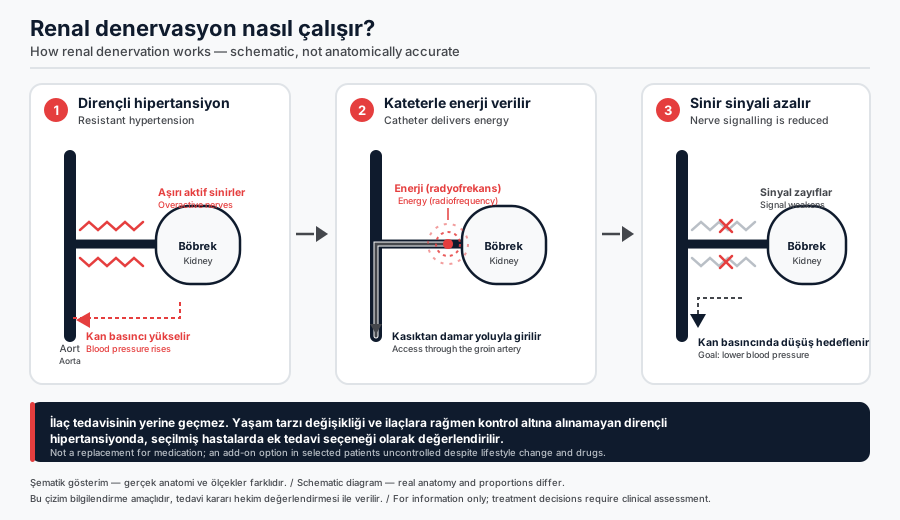
Renal denervation is a procedure in which a thin catheter is advanced through the groin (the femoral artery) and energy is delivered to the sympathetic nerve fibres surrounding the wall of the renal artery. The aim is to lower blood pressure by targeting the sympathetic nerves surrounding the renal artery; these nerve fibres originate from the abdominal ganglia and show a conical distribution towards the distal part of the vessel. The 2023 clinical consensus statement of the ESC Council on Hypertension and EAPCI defines the procedure as an adjunct treatment option in resistant hypertension that remains uncontrolled despite best efforts with lifestyle measures and medication. It does not replace medication: the 2024 ESC guidelines state that renal denervation is not recommended as a first-line intervention for lowering blood pressure, because adequately powered outcome trials demonstrating its safety and cardiovascular benefit are lacking.
Who may be considered?
The 2024 ESC guidelines state that renal denervation may be considered in patients whose blood pressure remains uncontrolled despite a triple drug combination including a thiazide or thiazide-like diuretic (Class IIb, Level of Evidence B). It may also be an option in patients at increased cardiovascular risk whose blood pressure is uncontrolled on fewer than three antihypertensive drugs (Class IIb). In both situations three conditions apply: the procedure should be performed in a medium-to-high-volume centre, a detailed multidisciplinary assessment should be carried out, and the patient should choose the procedure after a shared discussion of the benefits and risks. The 2025 AHA/ACC high blood pressure guideline likewise addresses the procedure as an adjunct option in resistant or uncontrolled hypertension, with a Class 2b recommendation.
The patient selection criteria of the ESC/EAPCI consensus are: office blood pressure ≥140/≥90 mmHg, confirmed by 24-hour ambulatory systolic blood pressure ≥130 mmHg or daytime systolic ≥135 mmHg; treatment with at least three antihypertensive drugs including a diuretic at appropriate doses; and an eGFR ≥40 mL/min/1.73 m². Patients who cannot tolerate multiple antihypertensive drugs may also be candidates; because of previous drug intolerance, such patients may be taking fewer than three drugs. Before the procedure is considered, pseudo-resistant hypertension and secondary causes of hypertension (primarily primary aldosteronism, renovascular disease and chronic kidney disease) are excluded; a frequently overlooked cause of pseudo-resistance is non-adherence to prescribed medication. The 2025 Turkish Hypertension Consensus Report, prepared with the contribution of the Turkish Society of Cardiology, likewise describes renal denervation as an option that may be considered in selected patients when all pharmacological treatment has proved insufficient.
Who should not undergo the procedure?
According to the 2024 ESC guidelines, until further evidence becomes available renal denervation is contraindicated in patients with moderate-to-advanced renal impairment (eGFR <40 mL/min/1.73 m²) and in patients with a secondary cause of hypertension. Because of a lack of evidence, it is also not recommended in:
- Kidney transplant recipients
- Severely impaired renal function (KDIGO stages G4–G5) and need for haemodialysis
- Fibromuscular dysplasia
- Untreated secondary hypertension
- A single functioning kidney
How is the procedure performed?
Before the procedure, non-invasive imaging of the renal arteries is performed; duplex ultrasound is the preferred screening method because of its wide availability and low cost. This anticipates anatomical features such as accessory renal arteries and excludes unsuitable vessel diameter, untreated significant atherosclerotic renal artery disease and fibromuscular dysplasia. Access is obtained through the groin, preferably by ultrasound-guided puncture; the catheter is advanced into the renal artery and energy is delivered to target the nerves surrounding the vessel wall. Two systems have demonstrated efficacy and safety in sham-controlled trials: Symplicity Spyral (multi-electrode radiofrequency, 6 Fr femoral access) and Paradise (ultrasound, 7 Fr femoral access). Both devices are suitable for accessible renal arteries 3–8 mm in diameter, and both received US Food and Drug Administration (FDA) approval in November 2023. Use of a vascular closure device for haemostasis is recommended in order to shorten the hospital stay.
What happens afterwards?
Complete interruption of the sympathetic nerves surrounding the renal artery is thought to take up to 90 days after the procedure, and there is no validated, readily applicable clinical marker of procedural success during the intervention. In sham-controlled trials, the reduction in 24-hour systolic blood pressure was −4.7 mmHg at 3 months versus −0.6 mmHg with sham in SPYRAL HTN-OFF MED Pivotal (2020), and −9.0 mmHg at 6 months versus −1.6 mmHg with sham in SPYRAL HTN-ON MED (2018). In RADIANCE-HTN TRIO (2021), the median change in daytime ambulatory systolic blood pressure at 2 months was −8.0 mmHg versus −3.0 mmHg with sham. By contrast, in the REQUIRE trial (2022) there was no significant difference between renal denervation and sham in the change in daytime ambulatory systolic blood pressure at 3 months (−6.6 mmHg versus −6.5 mmHg; p=0.971). The procedure therefore does not produce the expected effect in every patient, and apart from a high baseline blood pressure no patient characteristic has been identified as a consistent predictor of response. The blood pressure-lowering effect has been reported to persist for at least three years; follow-up data beyond three years are not available. As the procedure is an adjunct treatment, your antihypertensive medication is continued at your physician's discretion.
With regard to safety, the expert group identified no concern specific to renal denervation beyond the complication rates expected for a procedure involving femoral arterial access (below 1%) and the patient's radiation exposure. In Symplicity HTN-3, the largest sham-controlled trial, an access-site vascular complication occurred in 1 of 364 patients (0.3%). In a meta-analysis of 5,769 patients treated with radiofrequency renal denervation, the pooled annual incidence of renal artery stenting was 0.2%, similar to the natural incidence of renal artery stenosis in hypertension. As for renal function, a meta-analysis of 2,381 patients found no significant change in eGFR over a mean follow-up of 9.1 months.
When should you contact your doctor?
The information on this page is for general information only; whether the procedure is suitable for you can be decided only by the physician who assesses you, together with a multidisciplinary team of hypertension specialists and interventional cardiologists. Do not change or stop your medication on your own initiative. Contact your doctor if your home readings remain above the target your physician has set, if you experience a side effect you believe is related to your medication, or if you notice pain, swelling or bleeding at the groin access site after the procedure.
Sources
This page has been compiled from the guidelines and publications below. It is for information only and does not replace your physician's advice.
- ESC Council on Hypertension + EAPCI, 'Renal denervation in the management of hypertension in adults. A clinical consensus statement', EuroIntervention 2023;18:1227-1243 (Tablo 5 ve 'Procedur
- ESC Council on Hypertension + EAPCI Clinical Consensus Statement, EuroIntervention 2023;18:1227-1243 ('Preprocedural imaging' bölümü)
- ESC Council on Hypertension + EAPCI Clinical Consensus Statement, EuroIntervention 2023;18:1227-1243 (Şekil 5 açıklaması ve işlem başarısı bölümü)
- ESC/EAPCI Clinical Consensus Statement, EuroIntervention 2023 (Özet) + 2024 ESC Guidelines for the management of elevated blood pressure and hypertension (açık erişimli derleme: Medicina 202
- 2024 ESC Guidelines for the management of elevated blood pressure and hypertension (Eur Heart J 2024;45:3912-4018, Bölüm 8.6.1 ve Öneri Tablosu 20) — açık erişimli özet: Medicina 2025;61:193
- 2024 ESC Guidelines (Öneri Tablosu 20) — açık erişimli derleme: Medicina 2025;61:193
- 2024 ESC Guidelines (açık erişimli derleme: Medicina 2025;61:193) + ESC/EAPCI Clinical Consensus Statement, EuroIntervention 2023;18:1227-1243
- ESC Council on Hypertension + EAPCI Clinical Consensus Statement, EuroIntervention 2023;18:1227-1243
- ESC Council on Hypertension + EAPCI Clinical Consensus Statement, EuroIntervention 2023;18:1227-1243 ('RDN in resistant hypertension' bölümü)
- ESC Council on Hypertension + EAPCI Clinical Consensus Statement, EuroIntervention 2023;18:1227-1243 (Tablo 1, tamamlanmış sham kontrollü randomize çalışmalar)
Last updated: October 13, 2026