Balon Atriyal Septostomi
Balon atriyal septostomi, kalbin iki üst odacığı olan sağ ve sol atriyum arasındaki duvarda (atriyal septum) kateter ucundaki balonla açıklık oluşturulması ya da…
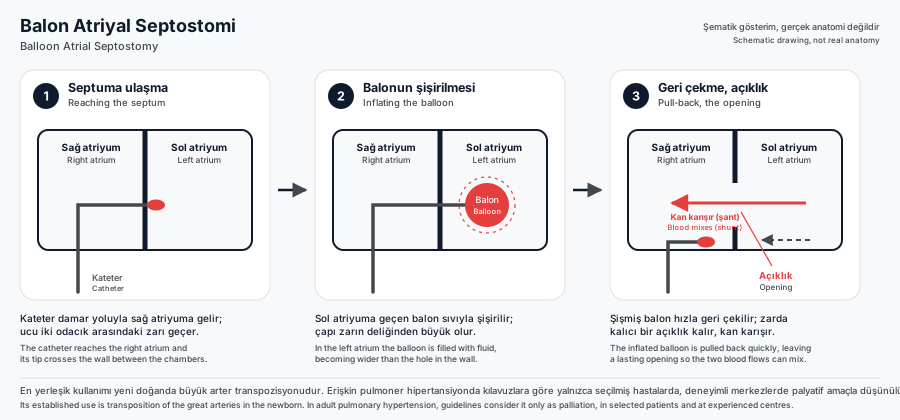
Balloon atrial septostomy is a catheter procedure in which a balloon at the catheter tip creates an opening in the wall between the heart's two upper chambers (the atrial septum), or enlarges an existing small opening. It was first described in 1966 by Rashkind and Miller, via the femoral vein, in infants with transposition of the great arteries.
When is it considered?
The best-established and most urgent indication is transposition of the great arteries in the newborn, particularly when there is no atrial communication or only a very restrictive one. In the review covering this topic, that indication is classified as Class I (the strongest). Indications supported by weaker evidence include:
- Hypoplastic left heart syndrome (IIa)
- Total anomalous pulmonary venous return with a restrictive atrial septal defect (IIb)
- Tricuspid atresia with a restrictive atrial septal defect (IIb)
- Pulmonary atresia with intact ventricular septum (IIb)
- Pulmonary hypertension unresponsive to medical therapy, before lung transplantation (IIb)
How is it performed in a newborn?
The baby is first supported with a prostaglandin E1 infusion, the aim being to keep the ductus arteriosus patent. When the atrial communication is restrictive, prostaglandin alone is not sufficient and balloon septostomy is required. The procedure can also be performed at the bedside in intensive care under echocardiographic guidance alone; in one published series the median age at the procedure was 4 days. Prostaglandin is then tapered gradually rather than stopped abruptly, because of the risk of rebound hypoxaemia.
In the same series oxygenation improved in 76% of patients, with a mean increase of 9% in SpO2; when success was defined as an increase of at least 10% in systemic arterial saturation, the overall success rate was 68.7%. The early complication rate was reported as 34.3%, but most of these were transient: metabolic acidosis and arterial hypotension 21.8%, cardiac arrhythmias 9.3%, deep vein thrombosis 3.1%.
What happens afterwards?
The procedure is not a definitive treatment but a temporary (palliative) step that prepares the baby for surgery. Definitive treatment is the arterial switch operation; in the same publication the optimal window was stated as "from the first days of life up to 3 weeks", with a median age at surgery of 13 days. In a retrospective database analysis of 8,681 neonates with transposition of the great arteries, mortality was lower in the group that underwent the procedure (10% versus 12%), whereas the risk of clinically recognised stroke was about twice as high; because this is a retrospective study, these findings do not prove causation.
Its place in adult pulmonary hypertension
Creating a right-to-left communication (shunt) between the atria reduces pressure in the right heart chambers and increases left ventricular preload and cardiac output, so that total oxygen delivery to the body rises even though arterial oxygen saturation falls. In the Turkish Society of Cardiology translation of the 2015 ESC/ERS guidelines, the recommended technique is graded balloon dilation atrial septostomy. The recommendation itself reads: "Balloon atrial septostomy may be considered, where available, after failure of maximal medical therapy" (Class IIb, Level of Evidence C; 2015 version). The same guideline states that the procedure should not be performed in end-stage patients with a baseline mean right atrial pressure above 20 mmHg and resting oxygen saturation below 85% on room air.
The current 2022 ESC/ERS guidelines state that "as these procedures are complex and high risk, including significant procedure-related mortality, they are rarely performed in PAH patients and may only be considered in centres experienced in these techniques". The 2015 AHA/ATS paediatric guideline recommends atrial septostomy in patients with persistent right ventricular failure, recurrent syncope or pulmonary hypertensive crisis despite optimised medical therapy (Class I, Level of Evidence B), again only in an experienced centre, and notes that it may serve as a bridge to lung transplantation.
In adults, procedure-related mortality has been reported across a wide range: in a review of 223 patients, 7.1% at 24 hours and 14.8% at 1 month. These figures depend on patient selection and centre experience. Survival data are observational; the 2015 ESC/ERS guidelines state explicitly that an effect on long-term survival has not been demonstrated in randomised trials. The created opening may close or become restrictive over time; series have reported patients in whom the procedure had to be repeated.
Talk to your own physician
The information on this page is for general education and is not personal medical advice. Whether this procedure is appropriate, its timing and its risks can only be determined by the physician who follows you or your child. If you notice an unexpected change in your condition, it is appropriate to contact your own physician or the centre following you.
Sources
This page has been compiled from the guidelines and publications below. It is for information only and does not replace your physician's advice.
- Pediatric Cardiology / PMC derleme: 'Balloon Atrial Septostomy' (PMC3869120) ve 'Atrial septostomy in the management of pulmonary arterial hypertension: past, present, and future' (2025, PMC
- PMC derleme 'Balloon Atrial Septostomy' (PMC3869120), Tablo 1
- Impact of Bedside Balloon Atrial Septostomy in Neonates with Transposition of the Great Arteries in a Neonatal Intensive Care Unit in Romania (2023, PMC10145815)
- Cardiology in the Young (Cambridge University Press), 'Analysis of 8681 neonates with transposition of the great arteries: outcomes with and without Rashkind balloon atrial septostomy', 2010
- 2015 ESC/ERS Pulmoner Hipertansiyon Tanı ve Tedavi Kılavuzu, Türkçe çevirisi (Türk Kardiyoloji Derneği Pulmoner Vasküler Hastalık Proje Grubu ve Türk Toraks Derneği), Bölüm 6.3.6
- 2015 ESC/ERS Pulmoner Hipertansiyon Tanı ve Tedavi Kılavuzu, Türkçe çevirisi (TKD Pulmoner Vasküler Hastalık Proje Grubu / Türk Toraks Derneği), Bölüm 6.3.6
- 2015 ESC/ERS Pulmoner Hipertansiyon Tanı ve Tedavi Kılavuzu, Türkçe çevirisi (TKD / Türk Toraks Derneği), Bölüm 6.3.6
- 2015 ESC/ERS Pulmoner Hipertansiyon Tanı ve Tedavi Kılavuzu, Türkçe çevirisi (TKD / Türk Toraks Derneği), Bölüm 6.3.6 ve Tablo 22
- 2022 ESC/ERS Guidelines for the diagnosis and treatment of pulmonary hypertension, European Heart Journal 2022;43(38):3618-3731, Bölüm 6.3.6.1
- Pediatric Pulmonary Hypertension: Guidelines From the American Heart Association and American Thoracic Society, Circulation 2015;132:2037-2099, Bölüm 11.5
Last updated: October 13, 2026