TAVI (Transkateter Aort Kapak İmplantasyonu)
Aort kapak darlığının tedavisinde kapalı yöntem olarak bilinen TAVI yöntemi dünya genelinde orta ve yüksek riskli hastalarda 1. basamak tedavi olarak önerilen tedavi yöntemidir.
Who are the canditates for the TAVI procedure?
TAVI procedure is not used for all patients with severe aortic valve stenosis. This closed method is only used for patients who are very high risk subjects considered unsuitable for surgery. If there is a chance of the patient for an open surgery and if the patient’s risk score is low, open surgery is preferably recommended.
However, this disease is the main native valve disease of older patients and there are several comorbid conditions in these old patients which directly effect both results of the open surgery and decrease survival.
Currently, there are some important risk scores which were developed according to the presence or absence of comorbid disease and conditions among patients with aortic valve stenosis. If the number of these risk factors are higher, the risk score will increase and mortality will increase by open surgery.
Thus, a patient with the diagnosis of aortic valve stenois must be evaluated by an heart team composed of an interventional cardiologist, a cardiologist, a cardiovascular anesthesiologist and a heart surgeon. If the patient’s risk score is high, and if there are important comorbid conditions, TAVI must be considered.
How can we do the closed method (TAVI)?
The groin arteries are the main vessels for us to reach to the aorta and left ventricle. We make little punctures by a small needle to the femoral artery and put a sheath into the femoral artery at our catheterization laboratory.
We send our catheters from this sheath in to the aorta . Then we cross the aortic valve by a special guidewire. After passing through the stenotic valve, a stiff guidewire is sent to the left ventricle.
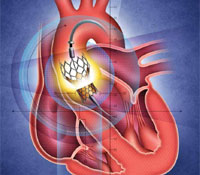
Over the stiff guidewire, a special balloon is sent to the aortic valve. The balloon is inflated and after aortic valvuloplasty, a specific catheter in which the new aortic valve is crimped is sent to the aorta. For the balloon expandable aortic valves, balloon will be inflated and for the self expandable aortic valves, the system will be opened amd the new valve will be implanted under fluoroscopy. (Figure 1: Implantation of balloon expandable aortic valve, Figure 2: Implantation of self expandable aortic valve).
Figure 1
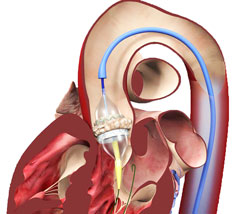
Figure 2
The groin artery cannot always be suitable for the implantation of a transcatheter aortic valve. In this situation, transapical, transaortic or transsubclavian approaches can be used.
What is the duration of the recovery period after the closed TAVI method?
After the TAVI procedure, the patient will stay on coronary care unit for one day the control period. If there is no complication, the patient will be discharged within three or four days. The normalization period will be within the one or two weeks after the procedure. However, these patients must take regularly some drugs and the control periods must be done one, three and 6 months after the procedure.
What are the advantages of TAVI compared to open surgery?
Compared to open surgery, this method has important advantages for a high risk patient. The hospital stay period is shorter, recovery is quick and complications are rare. The complications related to open heart surgery such as bleeding, trauma to great vessels or structures are not seen. Cosmetic superiority is also high because we do not open the chest. In the open heart surgery, the heart is stopped and extracorporeal circulation and a heart-lung pump is used. However during the TAVI procedure, the patient will not undergo to the extracorporeal circulation and no heart-lung pump is used. Thus, a negative effect on the performance of the heart will not develop.
What are the complications of the closed method (TAVI procedure)?
During the TAVI procedure, vascular complications such as injury to the groin arteries, hematoma, neurologic complications such as stroke, transient ischemic attack, paravalvular leaks, coronary complications or conduction disturbances and the need for a permanent pacemaker implantation can be developed. However, these complications are rare compared to open surgery.
Last updated: October 13, 2026