Aort Balon Tedavisi
Aort kapağı, kalbin sol karıncığı ile aort damarı arasında yer alır. Yaşla birlikte bu kapağın yapısının bozulması ve kireçlenmesi açıklığını daraltır;
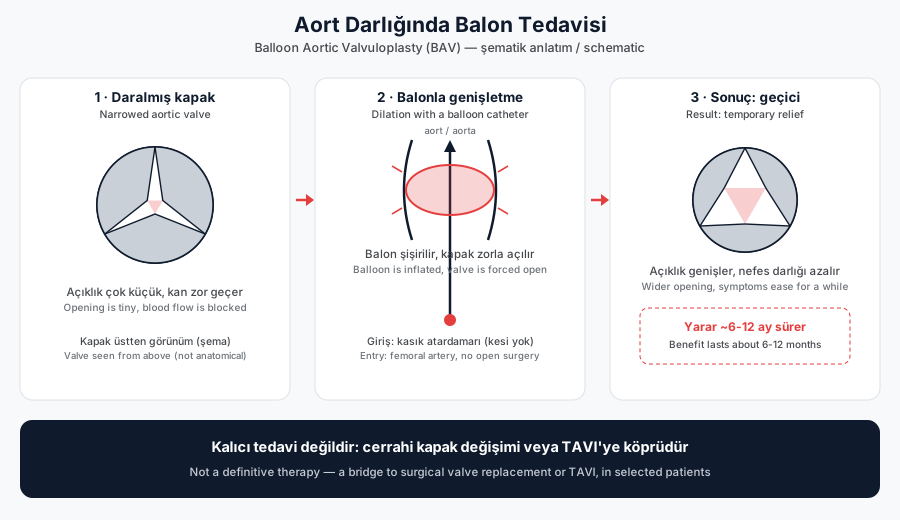
The aortic valve sits between the left ventricle and the aorta. With age, degeneration and calcification narrow its opening; this is called aortic stenosis. It can also develop earlier in life after childhood rheumatic fever or because of congenital valve abnormalities. Balloon treatment (balloon aortic valvuloplasty) means widening the narrowed valve with a balloon advanced from the groin.
Who is it considered for?
The main treatment of aortic stenosis is surgical valve replacement or repair. According to the Turkish Society of Cardiology patient information text, balloon dilation is performed only in patients who are not suitable for valve surgery.
The 2021 ESC/EACTS valvular heart disease guidelines describe it as an option that may be considered as a bridge to TAVI or surgical aortic valve replacement in decompensated aortic stenosis, and before urgent high-risk non-cardiac surgery; they state that it carries a significant risk of complications and should only be undertaken after Heart Team discussion. The 2020 ACC/AHA guideline recommends percutaneous aortic balloon dilation as a bridge to surgery or TAVI in critically ill patients with Class 2b, Level of Evidence C-EO; in guideline language this is the weakest "may be considered" category. The 2025 ESC/EACTS guidelines narrow the wording further, stating that it may "rarely" be considered as a bridge in carefully selected patients; in cardiogenic shock and acute heart failure, TAVI has largely replaced balloon valvuloplasty.
The situation differs in young adults with congenital aortic valve stenosis: the 2018 AHA/ACC guideline states, with Class 2b, Level of Evidence B-NR, that balloon valvuloplasty may be reasonable to delay the need for valve surgery when the valve is non-calcified and regurgitation is no more than mild; in calcified bicuspid valves it is less effective and carries a higher risk of regurgitation.
How is it performed?
As described by the Turkish Society of Cardiology, the procedure proceeds as follows:
- The groin is cleaned with antiseptic and numbed with a local anaesthetic.
- The artery is entered with a needle and a plastic sheath is placed, staying in position throughout.
- A long guidewire is advanced up to the valve under X-ray imaging (fluoroscopy).
- The balloon is placed inside the narrowed valve over the wire and inflated, several times if needed.
- The wire and balloon are removed; the groin sheath is taken out later and the site is compressed.
Preparation involves fasting from the night before the procedure (medicines may be taken with a little water), shaving both groins, and, in female patients, no suspicion of pregnancy.
What happens afterwards?
The balloon does not renew the valve; it cracks the calcified mass so the leaflets can open more easily. Postmortem and intraoperative studies have shown that success comes through fracture of calcific nodules, separation of fused leaflet commissures, or microfractures invisible to the naked eye.
The benefit is therefore not permanent. The Turkish Society of Cardiology text states that "the benefits of this repair last about 6-12 months"; the procedure does not remove the disease, it only aims to relieve problems caused by the narrowing. Re-narrowing develops in two ways: elastic recoil of the leaflets towards their previous position, and healing tissue forming after the injury caused by the balloon. A 2023 peer-reviewed review reports that procedural success in terms of pressure gradient and valve area now exceeds 95%, that restenosis at 6-month follow-up can reach up to 70%, and that the best long-term outcomes are obtained when the procedure is used as a bridge to TAVI or surgery.
Risks
The Turkish Society of Cardiology text states that the risk of death and disability is higher than with other diagnostic and therapeutic methods used in cardiology: myocardial infarction or a tear in the aortic valve, the aorta or the left ventricle occurs in 2%, the risk of stroke is around 4%, and procedure-related death ranges between 2% and 10%. In the United States national database analysis (2004-2013) cited by the 2021 ESC/EACTS guidelines, procedural death was 1.4%, in-hospital death 8.5%, stroke 1.8%, vascular access site complications 7.0% and the need for a permanent pacemaker 3.0%.
When should you see a doctor?
Severe aortic stenosis can cause chest pain, fainting and shortness of breath. The Turkish Society of Cardiology states that average survival after these complaints begin is less than 3 years; these symptoms should be evaluated without delay.
This page is for general information and is not personal medical advice. The treatment appropriate for you is decided by your own physician following Heart Team assessment.
Sources
This page has been compiled from the guidelines and publications below. It is for information only and does not replace your physician's advice.
- Türk Kardiyoloji Derneği – 'Aort Balon Valvüloplasti (Aort Kapağını Balon İle Genişletme) Hakkında Sık Sorulan Sorular' (hasta bilgilendirme sayfası, yayın/güncelleme tarihi sayfada belirtil
- Türk Kardiyoloji Derneği – Aort Balon Valvüloplasti SSS (hasta bilgilendirme sayfası)
- ESC/EACTS – 2021 Guidelines for the management of valvular heart disease (Eur Heart J 2022;43:561–632), bölüm 5.2 (tam metin PDF'de doğrulandı)
- ESC/EACTS – 2021 Guidelines for the management of valvular heart disease, bölüm 12.2.1 ve Şekil 11
- ACC/AHA – 2020 Guideline for the Management of Patients With Valvular Heart Disease, cep kılavuzu baskısı, bölüm 3.2.4.2 öneri tablosu (orijinal: Circulation 2021;143:e72–e227)
- ESC/EACTS – 2025 Guidelines for the management of valvular heart disease (Eur Heart J Valvular Heart Disease), bölüm 8.5
- ESC/EACTS – 2025 Guidelines for the management of valvular heart disease, bölüm 6.5
- McKay RG ve ark. – 'Postmortem and intraoperative balloon valvuloplasty of calcific aortic stenosis in elderly patients: mechanisms of successful dilation', J Am Coll Cardiol 1987 (hakemli d
- Hakemli literatür: 'Restenosis following successful balloon valvuloplasty: bone formation in aortic valve leaflets' (PubMed 8495464) ve aort valvüloplasti mekanizma derlemeleri (özet düzeyin
- Hakemli derleme – 'Balloon Aortic Valvuloplasty in the Transcatheter Aortic Valve Implantation Era' (PMC10339465, 2023)
Last updated: October 13, 2026