Dirençli Hipertansiyon
Bazı hastalarda tansiyon, doğru ilaçlar kullanılmasına rağmen hedefe inmez. 2024 ESC kılavuzu (Tablo 10) bu durumu şöyle tanımlar: uygun yaşam tarzı önlemlerinin…
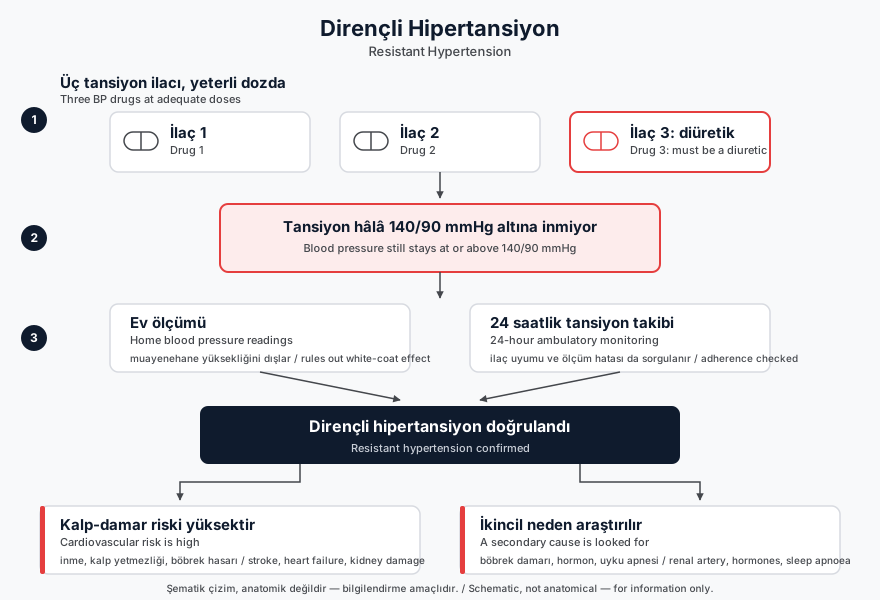
In some patients blood pressure (BP) does not reach target despite the right medicines. The 2024 ESC guideline (Table 10) defines this situation as follows: hypertension is “resistant” when appropriate lifestyle measures plus maximum or maximally tolerated doses of a diuretic (thiazide or thiazide-like), a renin-angiotensin system (RAS) blocker and a calcium channel blocker fail to lower office BP below 140/90 mmHg. Confirming these uncontrolled values by out-of-office measurement — home BP monitoring (HBPM) or ambulatory BP monitoring (ABPM) — is an inseparable part of the definition. In Türkiye, the 2025 Turkish Hypertension Consensus Report, written jointly by seven societies, uses the same three drug classes and the same office threshold of 140/90 mmHg, and recommends 24-hour ABPM, with a 130/80 mmHg threshold, to confirm office readings and exclude the white-coat phenomenon. If kidney function is markedly reduced (eGFR below 30 mL/min/1.73 m²), the diagnosis can be made only when an adequately up-titrated loop diuretic is being used (2024 ESC).
Resistant hypertension is not a disease
The 2024 ESC guideline states it plainly: resistant hypertension is not a disease per se, but a marker identifying a patient at high cardiovascular risk, and an underlying secondary cause of hypertension is common in these patients. Compared with patients whose BP is controlled, the risk of myocardial infarction, stroke, end-stage renal disease and death may be two- to six-fold higher. The same guideline reports that this picture has been described in 10%-20% of patients with hypertension.
The first question: true resistance or “pseudo-resistance”?
The 2025 Turkish consensus report requires that pseudo-resistant hypertension be excluded before the diagnosis is made. The 2024 ESC guideline (Table 11) lists the causes of pseudo-resistance as:
- Poor adherence to and persistence with treatment
- White-coat phenomenon (BP high only when measured in the clinic)
- Poor BP measurement method
- Marked calcification of the brachial artery (Osler phenomenon)
- Clinician inertia — inadequate doses or inappropriate drug combinations
Adherence is not a minor detail. In a systematic review and meta-analysis of 42 studies and 71,353 patients, pooled nonadherence among patients with apparent resistant hypertension was 37% (95% CI 27-47), rising to 46% when measured by direct methods such as directly observed treatment or detection of drug levels in blood or urine. The 2024 ESC guideline recommends that objective evaluation of adherence by these methods should be considered if resources allow (Class IIb, Level B).
What drives true resistance
The 2024 ESC guideline (Table 11) lists the behavioural factors as overweight and obesity, physical inactivity, excess daily dietary sodium (salt) intake and excess habitual alcohol consumption. The second heading is drugs and substances that may increase BP; among these the 2025 Turkish consensus report lists non-steroidal anti-inflammatory painkillers, nasal decongestants, glucocorticoids (cortisone drugs), paracetamol taken daily, oestrogen- and progestin-containing medicines, SNRI antidepressants, calcineurin inhibitors, erythropoiesis-stimulating agents, stimulants such as modafinil, amphetamines and methylphenidate, and vascular endothelial growth factor (VEGF) inhibitors. Tell your physician about every prescription, over-the-counter and herbal product you take, and do not stop or change any of them on your own. The third heading is undetected secondary hypertension.
Which tests are performed?
The 2024 ESC guideline (Table 13) and the 2025 Turkish consensus report set out the secondary causes to look for and their screening tests:
- Primary aldosteronism — aldosterone-to-renin ratio
- Renovascular hypertension — renal Doppler ultrasound, abdominal CT or MR angiography
- Phaeochromocytoma/paraganglioma — urinary and/or plasma metanephrine and normetanephrine
- Obstructive sleep apnoea — overnight polysomnography
- Renal parenchymal disease — creatinine, sodium, potassium, eGFR, urine dipstick and albumin-to-creatinine ratio, kidney ultrasound
- Cushing's syndrome — 24-hour urinary free cortisol, low-dose dexamethasone suppression test
- Thyroid disease — TSH (the Turkish report adds free T4)
- Hyperparathyroidism — parathyroid hormone, calcium, phosphate
- Coarctation of the aorta — echocardiography and CT aortography
Two of these stand out. Primary aldosteronism is the most common form of secondary hypertension; the 2024 ESC guideline stresses that most patients given this diagnosis do not have a history of low blood potassium, which is why the Turkish report asks for screening in resistant hypertension regardless of the potassium value. The guideline reports that only about 2% of eligible patients with resistant hypertension are actually screened, while the prevalence of hyperaldosteronism reaches up to 12% in patients with BP above 180/110 mmHg. The second is sleep apnoea: studies have shown features of obstructive sleep apnoea in up to 60% of patients with resistant hypertension, and the 2024 ESC guideline advises suspecting it in all patients with resistant hypertension. Absence of symptoms does not exclude it; diagnosis is made with a simplified polysomnogram (apnoea-hypopnoea index above 5; mild below 15, moderate 15-30, severe above 30).
What happens next?
The 2024 ESC guideline (Recommendation Table 12) advises that patients with resistant hypertension should be considered for referral to centres with expertise in hypertension management for further investigation (Class IIa, Level B), because this work-up is complex and requires technologies not usually available in primary care. The 2025 Turkish consensus report likewise describes referral to a tertiary centre or a hypertension centre as an appropriate approach. Kidney function guides how treatment is adjusted: according to the Turkish report, if eGFR is 30 mL/min/1.73 m² or above, the thiazide diuretic dose may be increased or switched to a more potent, longer-acting thiazide-like diuretic such as indapamide or chlorthalidone; if eGFR is below 30, loop diuretics such as furosemide, bumetanide or torsemide are preferred. These choices and doses are decisions for the physician who follows you.
When should you contact your physician?
- Your home readings stay above target even though you take three different BP medicines
- You have sleep-related complaints — the 2024 ESC guideline advises suspecting sleep apnoea in all patients with resistant hypertension
- A new medicine or supplement that can raise BP has been started
- You struggle to take a medicine because of side effects — report it rather than stopping the drug yourself
This page is general information. Which tests are needed, and at what dose and in what combination your medicines are used, are individual matters decided only by the physician who assesses you.
Sources
This page has been compiled from the guidelines and publications below. It is for information only and does not replace your physician's advice.
- European Society of Cardiology — 2024 ESC Guidelines for the management of elevated blood pressure and hypertension, Eur Heart J 2024;45(38):3912-4018, Tablo 10 (Bölüm 7.5)
- Türk Kardiyoloji Derneği ve 6 dernek ortak — Türk Hipertansiyon Uzlaşı Raporu 2025, "Dirençli Hipertansiyon" bölümü (s. 16-17)
- ESC — 2024 ESC Guidelines for the management of elevated blood pressure and hypertension, Eur Heart J 2024;45(38):3912-4018, Bölüm 7.5
- ESC — 2024 ESC Guidelines, Eur Heart J 2024;45(38):3912-4018, Tablo 11; ve Türk Hipertansiyon Uzlaşı Raporu 2025
- ESC — 2024 ESC Guidelines, Eur Heart J 2024;45(38):3912-4018, Tablo 11
- Durand H. ve ark. — "Nonadherence Is Common in Patients With Apparent Resistant Hypertension: A Systematic Review and Meta-analysis", American Journal of Hypertension 2023;36(7):394-403 (hak
- ESC — 2024 ESC Guidelines, Eur Heart J 2024;45(38):3912-4018, öneri tabloları
- ESC — 2024 ESC Guidelines, Eur Heart J 2024;45(38):3912-4018, Öneri Tablosu 12; ve Türk Hipertansiyon Uzlaşı Raporu 2025
- ESC — 2024 ESC Guidelines, Eur Heart J 2024;45(38):3912-4018, Bölüm 7.6.2 ve 9.14.2; Türk Hipertansiyon Uzlaşı Raporu 2025
- ESC — 2024 ESC Guidelines, Eur Heart J 2024;45(38):3912-4018, Bölüm 7.6
Last updated: October 13, 2026