Stent Takılması
Koroner stent takılması, kalbi besleyen atardamarlardaki darlığın kateterle açılması ve açılan bölgeye damarı içeriden destekleyen ince metal bir ağın (stent)…
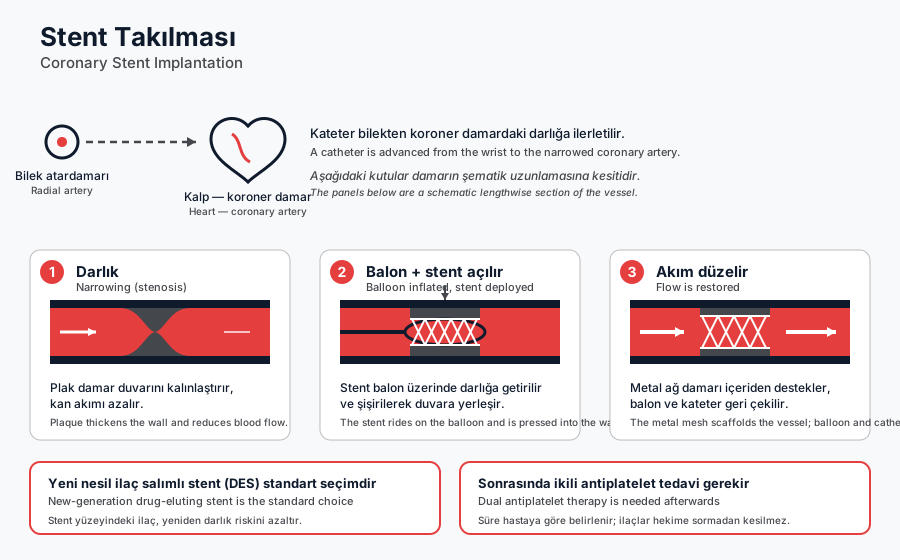
Coronary stent implantation means opening a narrowing in a heart artery with a catheter and placing a fine metal mesh (a stent) that supports the vessel wall from inside. According to the 2018 ESC/EACTS guidelines on myocardial revascularization, implantation of a new-generation drug-eluting stent (DES) is the standard interventional treatment strategy for coronary narrowing. Whether an intervention is needed is decided by your own physician.
What is a drug-eluting stent?
As the guideline defines it, a new-generation DES consists of a biocompatible (durable or bioresorbable) polymer coating, exclusively sirolimus-analogue active drugs, and a metal stent backbone with thin struts of 50–100 micrometres. The drug on the stent is there to reduce renarrowing (restenosis) in the treated segment. According to the guideline, early-generation drug-eluting stents reduced angiographic and clinical restenosis by roughly 50–70% compared with bare-metal stents (BMS), but increased the risk of very late stent thrombosis (a clot inside the stent), again compared with BMS; the new-generation stents that replaced them carry a significantly lower risk of subacute and late stent thrombosis than BMS. DES are recommended over BMS for any percutaneous coronary intervention, irrespective of clinical presentation, lesion type, planned non-cardiac surgery, anticipated duration of dual antiplatelet therapy or concomitant anticoagulant therapy (Class I, Level of Evidence A).
How is the procedure performed?
The preferred access route is the artery at the wrist (radial artery). When invasive coronary angiography is indicated, the 2024 ESC chronic coronary syndrome guidelines recommend radial artery access as the preferred access site (Class I, Level A), as it is associated with a reduction in mortality and in major bleeding requiring transfusion. The 2018 ESC/EACTS guidelines likewise recommend radial access as the standard approach, unless there are overriding procedural considerations (Class I, Level A). For anatomically complex lesions, particularly the left main, intracoronary imaging guidance by intravascular ultrasound (IVUS) or optical coherence tomography (OCT) is recommended (Class I, Level A). The detailed steps, the duration, hospital stay and return to daily activity vary from person to person; ask your physician about these.
Medication after the procedure
Two antiplatelet drugs are given together after stenting (dual antiplatelet therapy, DAPT) to reduce the risk of stent thrombosis and myocardial infarction compared with aspirin alone. The duration is not the same for every patient; your physician decides it according to your bleeding and ischaemic risk.
- After an elective procedure, in chronic coronary syndrome patients with no indication for oral anticoagulation, the default duration in the 2024 ESC guidelines is 6 months (aspirin plus clopidogrel; Class I, Level A).
- In patients at high bleeding risk who are not at high ischaemic risk, stepping down to a single antiplatelet drug 1–3 months after the procedure is recommended (Class I, Level A).
- If the stent was implanted because of an acute coronary syndrome (a heart attack or a similar acute presentation), the default duration in the 2023 ESC guidelines is generally 12 months, irrespective of stent type and absent contraindications (aspirin plus prasugrel or ticagrelor). The 2025 ACC/AHA guideline likewise recommends at least 12 months after hospital discharge in patients at low bleeding risk.
- After DAPT, lifelong single antiplatelet therapy is recommended, usually aspirin, or clopidogrel if aspirin is not tolerated (Class I, Level A).
Renarrowing (restenosis)
In-stent restenosis develops through tissue overgrowth in response to vessel wall injury (neointimal hyperplasia), or through neoatherosclerosis in the stented segment. Although far less frequent than after a bare-metal stent, clinical restenosis after DES implantation reaches up to 10% within the first 10 years and remains the most frequent cause of procedural failure. A peer-reviewed meta-analysis reported diabetes, the number of stents implanted, involvement of the left anterior descending (LAD) artery and previous PCI as independent risk factors. Restenosis can be treated: for in-DES restenosis the guideline recommends a drug-eluting stent in preference to a drug-coated balloon (Class I, Level A).
When should you contact your doctor?
Do not stop your antiplatelet medication on your own or earlier than planned — the guidelines specifically advise patients against this. Before a dental extraction, an endoscopy or surgery, always ask your physician what to do about your medication. Restenosis most often presents as a chronic coronary syndrome; about 20% presents as an acute coronary syndrome and the rest is silent. Therefore, if your chest symptoms are new or worsening, contact your physician without delay, and follow your physician's advice on how often to attend follow-up visits even if you feel well. This text is for general information and does not replace assessment by a physician.
Sources
This page has been compiled from the guidelines and publications below. It is for information only and does not replace your physician's advice.
- European Society of Cardiology / EACTS — 2018 ESC/EACTS Guidelines on myocardial revascularization (European Heart Journal 2019;40:87–165), 2018
- European Society of Cardiology / EACTS — 2018 ESC/EACTS Guidelines on myocardial revascularization, Bölüm 16.1 (Stent seçimi), 2018
- European Society of Cardiology / EACTS — 2018 ESC/EACTS Guidelines on myocardial revascularization, 'Recommendations on choice of stent and access site' tablosu, 2018
- European Society of Cardiology — 2024 ESC Guidelines for the management of chronic coronary syndromes (European Heart Journal 2024;45:3415–3537), 2024; ve 2018 ESC/EACTS revaskülarizasyon kı
- European Society of Cardiology — 2024 ESC Guidelines for the management of chronic coronary syndromes, revaskülarizasyon öneri tablosu, 2024
- American College of Cardiology / American Heart Association — 2025 ACC/AHA/ACEP/NAEMSP/SCAI Guideline for the Management of Patients With Acute Coronary Syndromes (ACC resmi basın duyurusu),
- European Society of Cardiology — 2024 ESC Guidelines for the management of chronic coronary syndromes, Bölüm 4.3.1.1.3 ve antitrombotik tedavi öneri tablosu, 2024
- European Society of Cardiology — 2024 ESC Guidelines for the management of chronic coronary syndromes, antitrombotik tedavi öneri tablosu, 2024
- European Society of Cardiology — 2023 ESC Guidelines for the management of acute coronary syndromes (European Heart Journal 2023;44:3720–3826), Bölüm 6.3, 2023
- European Society of Cardiology — 2024 ESC Guidelines for the management of chronic coronary syndromes, Bölüm 4.3.1.1.3, 2024
Last updated: October 13, 2026