Rotablator
Yoğun kalsifik koroner lezyonların dönen elmas uçlu kateter ile aşındırılarak perkütan girişime uygun hale getirilmesi.
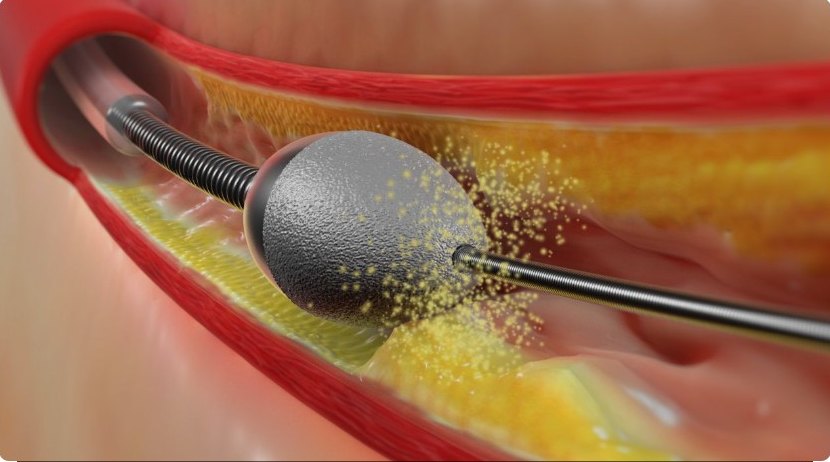
Rotational atherectomy, widely known by the device name Rotablator, is a catheter technique for heavily calcified narrowings in the arteries supplying the heart. At the catheter tip sits a small, olive-shaped metal burr coated with diamond crystals. It rotates at high speed to pulverise hard calcified tissue and help prepare the vessel for a stent.
How does it work?
The technique relies on differential cutting: the rotating burr abrades hard, non-elastic calcified tissue while sparing the adjacent elastic (healthy) vessel wall. The released particles are small enough to pass through the capillary circulation and are cleared by the liver, lungs and spleen.
Who is it considered for?
It is not used in every angioplasty but reserved for selected patients: the European expert consensus (EuroIntervention 2015) reports it in only 0.8–3.1% of all percutaneous coronary interventions in Europe. The 2021 ACC/AHA/SCAI revascularization guideline states that plaque modification with rotational atherectomy "can be useful" to improve procedural success in fibrotic or heavily calcified lesions (Class 2a, level of evidence B-R). The 2018 ESC/EACTS guidelines note that it may be required in heavily calcified lesions to dilate them adequately before stenting, but that its routine use has not shown a clear clinical benefit.
In the 2023 position paper of the Spanish Society of Cardiology, the most suitable targets are concentric calcified narrowings and lesions a balloon cannot cross or expand. On intravascular imaging (OCT/IVUS), the same paper notes that a calcium arc beyond 50% of the vessel circumference (180 degrees), a length over 5 mm or a thickness over 0.5 mm indicates a need for advanced plaque modification.
How is the procedure performed?
- The 2018 ESC/EACTS guidelines recommend radial (arm artery) access as the standard approach for coronary procedures (Class I, level of evidence A); according to the 2015 European expert consensus a 6 F guide catheter takes burrs up to 1.75 mm, so this route is usually suitable.
- According to the manufacturer's reference guide (Boston Scientific, 2014) and the 2015 European expert consensus, burr diameters range from 1.25 to 2.50 mm, 1.5 mm being the most used, and the burr is chosen at roughly 0.4–0.6 times the vessel diameter. The same consensus recommends 135,000–180,000 revolutions per minute.
- The burr is brought just before the narrowing and moved through it with a gentle back-and-forth "pecking" motion. In the manufacturer's reference guide and the 2014 review in the Archives of the Turkish Society of Cardiology, each run is kept under 30 seconds and total rotation time should not exceed 5 minutes; a final "polishing" run passed without resistance completes the procedure.
What is known about the outcomes?
In the randomised PREPARE-CALC trial (2018, 200 patients), strategy success was 98% with rotational atherectomy versus 81% with modified balloons (p=0.0001), with no significant difference in dissection, perforation or slow flow. In ROTAXUS (2013, 240 patients), strategy success was 92.5% versus 83.3% (p=0.03), but in-stent late lumen loss at nine months was higher in the rotational atherectomy arm (0.44 mm versus 0.31 mm; p=0.04), while major adverse cardiac events were similar in both arms (24.2% versus 28.3%; p=0.46). In ICARE-OFDI (169 patients), comparing the technique with Shockwave intravascular lithotripsy, target lesion failure at 12 months was equivalent: 1.2% with rotational atherectomy versus 2.4% with lithotripsy (p=0.61); the choice depends on where the calcium sits.
What are the possible risks?
The 2023 position paper reports slow flow or no reflow in 2.6% of cases; in the 2014 review in the Archives of the Turkish Society of Cardiology, more than 60% of these events are reversible and respond rapidly to intracoronary calcium channel blockers. Transient heart block is more common in the right coronary artery or a dominant circumflex artery; vessel perforation, burr entrapment and dissection are rare.
Per the manufacturer's instructions for use, the technique is not used in occlusions the guidewire cannot cross, in saphenous vein grafts, in vessels where thrombus is detected, or where significant dissection is present. Higher risk is reported in unprotected left main disease, an ejection fraction below 30%, and lesions longer than 25 mm or angulated more than 45 degrees.
When should you contact your doctor?
The information on this page is general and does not replace an individual medical assessment. Which technique suits which vessel, and the possible benefits and risks for you, can be determined only by your own doctor, who knows you and reviews your imaging. If you develop new symptoms, or your symptoms change, contact your own doctor.
Sources
This page has been compiled from the guidelines and publications below. It is for information only and does not replace your physician's advice.
- ACI-SEC (İspanya Kardiyoloji Derneği Girişimsel Kardiyoloji Birliği) pozisyon belgesi: Plaque modification techniques to treat calcified coronary lesions, REC: Interventional Cardiology 2023
- Türk Kardiyoloji Derneği Arşivi, derleme: "Kompleks koroner arter lezyonları ile savaşta etkili bir silah: Rotablator cihazı", Turk Kardiyol Dern Ars 2014;42(3):302-310
- Boston Scientific, Rotablator System Reference Guide (IC-193906-AA, APR2014) — başlık çapları ve 0.25 mm adımla büyütme; EAPCI onaylı European expert consensus on rotational atherectomy, Eur
- Boston Scientific, Rotablator System Reference Guide (IC-193906-AA, 2014); European expert consensus on rotational atherectomy (EAPCI onaylı), EuroIntervention 2015;11(1)
- Boston Scientific, Rotablator System Reference Guide (IC-193906-AA, 2014); Türk Kardiyoloji Derneği Arşivi 2014;42(3):302-310 (ablasyon ~30 saniye, toplam süre 5 dakikayı geçmemeli)
- 2021 ACC/AHA/SCAI Guideline for Coronary Artery Revascularization, J Am Coll Cardiol / Circulation 2022 (Bölüm 10.5)
- 2018 ESC/EACTS Guidelines on myocardial revascularization, Eur Heart J 2019;40:87-165 (kabul edilmiş tam metin, bölüm 16.1.5); ESC Guidelines Publication Schedule (2028 planlı revaskülarizas
- PREPARE-CALC, Circulation: Cardiovascular Interventions 2018 (Abdel-Wahab ve ark.); sayısal değerler ACI-SEC pozisyon belgesi, REC: Interventional Cardiology 2023;5:46-61 üzerinden doğruland
- ROTAXUS, JACC: Cardiovascular Interventions 2013;6(1):10-19 (Abdel-Wahab ve ark.); sayısal değerler ACI-SEC pozisyon belgesi, REC: Interventional Cardiology 2023;5:46-61 üzerinden doğrulandı
- ACI-SEC pozisyon belgesi, REC: Interventional Cardiology 2023;5:46-61; Türk Kardiyoloji Derneği Arşivi 2014;42(3):302-310
Last updated: October 13, 2026