FFR Uygulaması
FFR (fraksiyonel akım rezervi), koroner anjiyografi sırasında bir kalp atardamarındaki darlığın kan akımını gerçekten kısıtlayıp kısıtlamadığını ölçen yöntemdir.
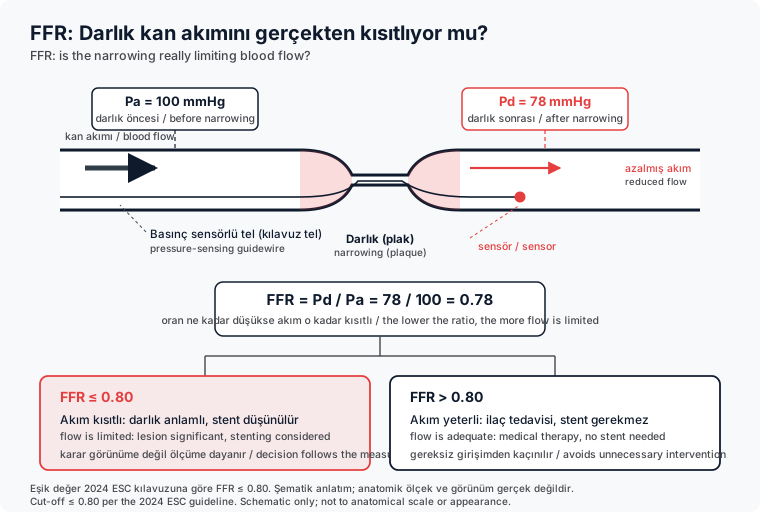
Fractional flow reserve (FFR) is a measurement made during coronary angiography to show whether a narrowing in a heart artery truly limits blood flow. It is defined as the ratio of maximal hyperaemic myocardial blood flow across a stenosed artery to the maximal myocardial blood flow across the same artery in the theoretical absence of the stenosis. In practice it is calculated as the ratio of mean distal coronary pressure (Pd) to aortic pressure (Pa) during maximal flow: FFR = Pd/Pa. The theoretical FFR of a normal coronary artery is 1.0, and this value does not vary from patient to patient or from vessel to vessel.
Why is it performed?
How narrow a lesion looks on the angiogram does not always mean that it restricts blood flow to the heart muscle. The 2024 ESC Guidelines for the management of chronic coronary syndromes state that haemodynamic significance defined by FFR 0.80 (or iFR 0.89) correlates poorly with visually assessed diameter stenosis: only 35% of 50-70% stenoses are haemodynamically significant, 20% of 71-90% stenoses are not significant, and only stenoses above 90% predict significance with high accuracy (96% correct classification). The guidelines report that adding FFR to angiography was associated with reclassification of the treatment plan in 30-50% of cases in large management studies.
Who is assessed?
Measurement is considered for "intermediate" stenoses. The 2024 ESC guidelines define these, on visual assessment, as typically 40-90% diameter stenosis in non-left main vessels and 40-70% in left main stenoses. Functional assessment of intermediate non-left main stenoses before revascularisation is recommended (Class I, Level of Evidence A); in intermediate left main stenoses measurement should be considered (Class IIa, Level A). By contrast, systematic routine pressure wire assessment of all coronary vessels is not recommended (Class III, Level A).
How is it done?
A 0.014 inch (about 0.36 mm) guidewire with a pressure sensor at its tip is advanced through the guiding catheter into the target artery. Before the narrowing is crossed, the wire pressure signal is calibrated against the guiding catheter signal, and the wire is then advanced beyond the stenosis. Maximal flow (maximal hyperaemia) is most often induced with adenosine given intravenously or intracoronary; an expert consensus document reports a standard intravenous dose of 140 µg/kg/min for continuous hyperaemia and intracoronary bolus doses of 40-200 µg, with a lower dose advised for the right coronary artery.
How is the result interpreted?
In the 2024 ESC guidelines the threshold for significance is ≤0.80 for FFR, ≤0.89 for iFR and ≤0.80 for angiography-derived QFR. According to a review published in EuroIntervention, the interventional cardiology journal of the EAPCI/ESC, FFR values below 0.75 are almost invariably associated with myocardial ischaemia (overall accuracy 93%), whereas values above 0.80 are associated with negative ischaemia testing (95% predictive accuracy). The 0.75-0.80 range in between is a zone of uncertainty, and the expert consensus document notes that 0.80 is not a single, absolute cut-off. The guidelines emphasise that these thresholds must be interpreted together with careful assessment of the patient's symptoms and the results of non-invasive stress testing.
What happens afterwards?
Lesions above the threshold may have intervention deferred: the 2021 ACC/AHA/SCAI Guideline for Coronary Artery Revascularization states that PCI should not be performed in stable patients with an angiographically intermediate stenosis and FFR >0.80 (or iFR >0.89) (Class 3: No Benefit, Level B-R). In the 15-year follow-up of the DEFER trial, among patients with FFR ≥0.75 the rate of myocardial infarction was 2.2% in those whose stent was deferred and 10.0% in those who received a stent, while mortality was similar (the threshold used in that trial was 0.75). In the FAME trial, which enrolled 1005 patients with multivessel disease, the one-year rate of death, myocardial infarction or repeat revascularisation was 13.2% with FFR-guided PCI versus 18.3% with angiography-guided PCI, and the mean number of stents per patient was 1.9±1.3 versus 2.7±1.2. In the five-year results of FAME 2, the primary endpoint occurred in 13.9% of patients whose functionally significant lesion was treated with PCI versus 27.0% of those on medical therapy alone, a difference driven largely by the need for urgent revascularisation. Because residual ischaemia is found in about a quarter of patients after an angiographically successful procedure, pressure measurement at the end of the procedure may also be considered (Class IIa).
Talk to your own doctor
An FFR value is not a treatment decision on its own; it is weighed together with your symptoms and your other test results. Discuss with your own physician whether the measurement is appropriate for you, what your result means and what the next steps are. The information on this page is general information and does not replace individual medical advice.
Sources
This page has been compiled from the guidelines and publications below. It is for information only and does not replace your physician's advice.
- EuroIntervention (EAPCI/ESC resmi girişimsel kardiyoloji dergisi) — 'Physiological assessment of coronary haemodynamics: fractional flow reserve and beyond' derlemesi
- European Society of Cardiology — 2024 ESC Guidelines for the management of chronic coronary syndromes, Recommendation Table 12 (Eur Heart J 2024, doi:10.1093/eurheartj/ehae177)
- European Society of Cardiology — 2024 ESC Guidelines for the management of chronic coronary syndromes, Recommendation Table 11 ve dipnot c
- European Society of Cardiology — 2024 ESC Guidelines for the management of chronic coronary syndromes, Bölüm 3.3.3.2
- European Society of Cardiology — 2024 ESC Guidelines for the management of chronic coronary syndromes, Recommendation Table 12 ve Bölüm 3.3.3.2
- American College of Cardiology / American Heart Association / SCAI — 2021 ACC/AHA/SCAI Guideline for Coronary Artery Revascularization (Circulation 2022;145:e18-e114, doi:10.1161/CIR.0000000
- Tonino PA ve ark. — FAME çalışması, New England Journal of Medicine 2009;360:213-224 (doi:10.1056/NEJMoa0807611); sayısal değerler Interventional Cardiology Review derlemesi ve NEJM tablo ve
- Xaplanteris P ve ark. — FAME 2, 'Five-Year Outcomes with PCI Guided by Fractional Flow Reserve', New England Journal of Medicine 2018 (doi:10.1056/NEJMoa1803538)
- Zimmermann FM ve ark. — '15-year follow-up of the DEFER trial', European Heart Journal 2015;36:3182-3188 (doi:10.1093/eurheartj/ehv452)
- EuroIntervention derlemesi (yöntem) + Interventional Cardiology Review — 'Performing and Interpreting Fractional Flow Reserve Measurements in Clinical Practice: An Expert Consensus Document'
Last updated: October 13, 2026